
Three days at AI Infra Summit 2026 in Santa Clara gave us something that is difficult to get from specifications, product announcements, or architecture diagrams: repeated conversations with the people actually building, selling, operating, and planning the next generation of AI infrastructure.
At the DYNANIC booth, several themes came up again and again. Some confirmed what we expected. Others changed how we think about where the market is heading.
One shift was particularly hard to miss. For a long time, much of the AI infrastructure discussion was dominated by compute: more accelerators, faster memory, higher density. At AI Infra Summit 2026, the conversation had clearly moved further down the stack.
The question is increasingly not only how much compute can we deploy. It is how do we connect it, scale it, and keep it efficiently utilized?
That shift puts networking much closer to the center of the AI infrastructure discussion. And it was visible throughout the event.
What DYNANIC brought to AI Infra Summit 2026
Our focus in Santa Clara was Ultra Ethernet RDMA at 400G.
DYNANIC demonstrated a working FPGA-based Ultra Ethernet implementation capable of up to 400 Gbps per card in each direction, with full Ultra Ethernet support exposed through the standard libfabric API. The programmable data path also allows future protocol revisions to be introduced through FPGA firmware rather than making every change dependent on another generation of hardware.
Why does that matter?
Large AI training and inference workloads are not limited by bandwidth alone. Collective operations repeatedly synchronize compute nodes, so stalls in the fabric translate directly into idle compute.
Ultra Ethernet evolves RDMA over Ethernet for these traffic patterns with mechanisms including multipath packet spraying, flexible packet ordering, selective retransmission, and more scalable congestion control.
But the event was not only about the booth.
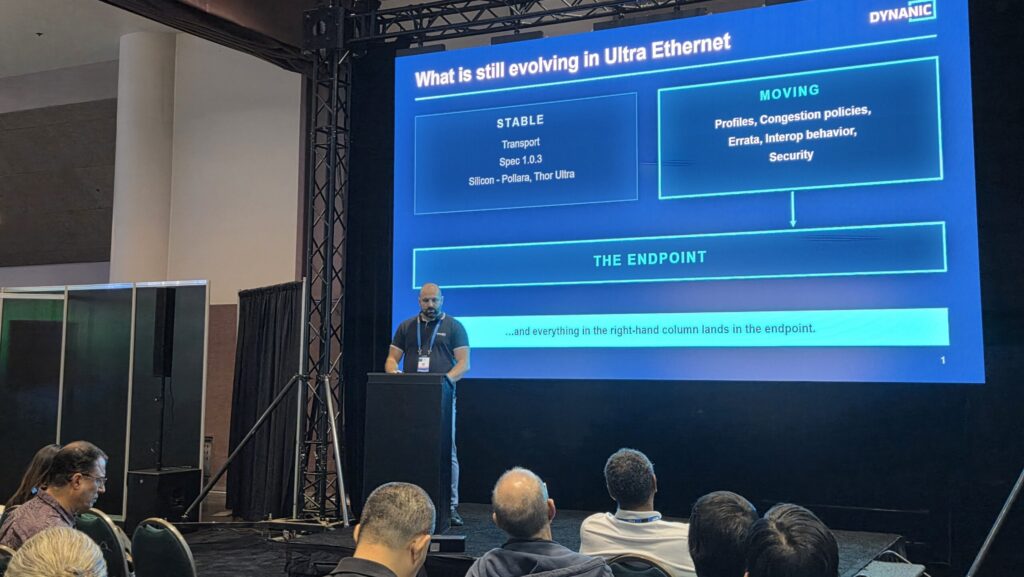
DYNANIC CTO and Co-Founder Lukáš Kekely presented: Keeping pace with AI protocol evolution: Scaling next-gen infrastructure via software-configurable FPGA pipelines. His session focused on a question that came up repeatedly during the summit: How can networking infrastructure keep pace with protocols that are still evolving without making every protocol revision dependent on the next silicon generation?
Still, the most useful part of the event was not what we presented. It was what we heard.
1. Ultra Ethernet is on every roadmap, but rarely in the rack yet
Ultra Ethernet came up again and again. Across many of our conversations, the answer was remarkably consistent:
Yes, Ultra Ethernet is part of the next-generation plan.
The harder question was what it would actually run on. Specifications and roadmaps are moving faster than deployed infrastructure. Teams understand why Ultra Ethernet matters for future AI clusters, but practical deployment options are still catching up. That creates an unusual period in the market. The direction is becoming clearer before the hardware ecosystem is fully mature.
For infrastructure teams, the question is therefore shifting from:
“Do we need Ultra Ethernet?” to: “When can we realistically start evaluating it?”
That gap between protocol roadmap and deployed hardware was one of the most consistent themes we heard during the event.
2. AI networking is not one market
AI infrastructure sounds like one category. In practice, the networking requirements behind that label vary enormously.
During the same event, we spoke with organizations for which 10G networking is still perfectly adequate today, while others are already looking beyond 400G toward the next generation of interconnect.
Both are building AI infrastructure. Both have rational requirements. They are simply operating at very different points in the scaling curve. This matters because the industry often talks about AI networking as though every organization were solving the same problem. They are not.
For some teams, the immediate priority is maximizing the infrastructure they already have. For others, it is moving to 100G or 400G. And at the leading edge, the discussion has already shifted to what comes after 400G.
The implication is simple: There is no single “AI networking customer.”
Product strategy, messaging, and architecture all need to reflect where an organization actually sits on that curve.
3. The default strategy is not protocol selection. It is hedging.
Ultra Ethernet was only one of several technologies discussed during the event. Across the market, infrastructure teams are watching multiple approaches evolve at the same time: different RDMA transports, scale-up technologies, memory-centric architectures, and proprietary fabrics.
What stood out was not strong commitment to one path. It was the reluctance to commit too early. And that is understandable.
Networking infrastructure has a long lifecycle. Choosing an architecture that cannot adapt to the next protocol revision can turn a technical decision today into a hardware replacement project tomorrow.
So the requirement we increasingly see is not simply: “Support protocol X.” It is: “Do not force us to make an irreversible decision before the market settles.”
That changes the value of programmability. It becomes less about adding another feature and more about maintaining optionality while standards, workloads, and deployment models continue to evolve.
4. Compute has an owner. The fabric often does not.
Perhaps the most strategically interesting observation came from conversations with companies developing AI compute platforms. The compute layer is deeply differentiated. Teams invest years into accelerator architectures, memory hierarchies, software stacks, and system design.
But when the discussion moves beyond the node and into scale-out networking, the answer can become much less specific. The accelerator is strategic. The network interface is often something to procure.
In more than one conversation, organizations could describe the compute architecture of a system in extraordinary detail while having much less clarity about the networking layer connecting it.
That suggests an important structural gap in the current AI stack:
Compute has clear ownership. The scale-out fabric often does not.
At the same time, we saw another encouraging pattern.
A number of companies building their own AI silicon are deliberately combining purpose-built compute with FPGA-based cards elsewhere in the architecture. That is an important signal. Even organizations investing heavily in custom silicon still see value in keeping part of the system programmable. Because protocols, interfaces, and infrastructure requirements continue to change faster than fixed hardware cycles.
For DYNANIC, it was particularly encouraging to see flexibility being treated not as an alternative to specialized silicon, but as a complement to it.
As accelerator performance grows and distributed workloads scale across more nodes, networking stops supporting infrastructure and starts becoming part of system performance itself.
In other words, the AI infrastructure conversation is moving from: “How much compute can we build?” toward: “How efficiently can we connect and use it?”
For us, this may be the most important takeaway from the entire event.
What this means for programmable networking
None of these observations point to one protocol winning every deployment. If anything, they point in the opposite direction. The market is moving quickly, but not uniformly.
Ultra Ethernet adoption is accelerating, networking requirements differ dramatically between AI infrastructure operators, and several architectural approaches are evolving in parallel. And AI infrastructure is not a problem any one company can solve on its own. Accelerators, network adapters, switches, transports, software interfaces, and applications ultimately have to work together. The value of a new protocol depends not only on what it can do in isolation, but on whether the ecosystem around it can interoperate. That is also why we are pleased to be building a closer relationship with the Ultra Ethernet Consortium and to contribute to the work around interoperability.
For DYNANIC, this matters beyond standards work itself. A programmable implementation is most useful when it can be tested, integrated, and validated against the wider ecosystem it is ultimately expected to operate in. That makes adaptability increasingly valuable.
DYNANIC’s approach is to put high-speed packet processing into a programmable FPGA data path while exposing the functionality through standard software interfaces. With the Ultra Ethernet implementation shown at AI Infra Summit 2026, that means up to 400 Gbps per card, integration through the standard libfabric API, and the ability to introduce future protocol revisions through firmware.
The goal is not to predict every protocol decision infrastructure teams will make. It is to make those decisions less permanent.
Three days, one broader conclusion
AI infrastructure is becoming a systems problem while compute remains critical. But the questions are increasingly moving beyond the accelerator itself.
● How does the fabric behave under synchronized workloads?
● Which transport will become relevant for a particular deployment?
● How quickly can an architecture react when standards change?
And how do all the pieces remain interoperable as the ecosystem develops?
Those are no longer secondary networking questions. They are increasingly part of the AI infrastructure architecture itself. That was perhaps the clearest message we brought back from AI Infra Summit 2026 in Santa Clara.
Continue the discussion
If any of these patterns sound familiar from your own AI or HPC infrastructure roadmap, talk directly with DYNANIC CTO & Co-Founder Lukáš Kekely about Ultra Ethernet, 400G networking, programmable packet processing, or the evolution of AI networking protocols.
Book a call with Lukáš:
https://calendar.app.google/ZovnVgoENa1QZgP16
Or explore how DYNANIC’s programmable networking technology could fit into your infrastructure.