
Nethost has deployed DYNANIC’s FPGA-based post-quantum security solution to protect communication between its cloud locations at up to 100 Gbps per direction. The deployment demonstrates how programmable networking hardware can address new security requirements in production infrastructure.
Nethost is a Czech cloud and hosting provider with more than 25 years of experience operating server infrastructure. Its geographically distributed cloud supports business-critical applications, Kubernetes platforms and services requiring high availability.
As Nethost expands across multiple locations, protecting data moving between them is essential for geo-redundancy and disaster recovery. Post-quantum cryptography addresses the “harvest now, decrypt later” threat: traffic intercepted today could otherwise become readable when sufficiently powerful quantum computers emerge.
Two gateways. Encryption inside the FPGA
An FPGA SmartNIC gateway at each site sits between the local network and the inter-datacenter link. The gateways establish cryptographic keys using ML-KEM-based post-quantum key establishment, then encrypt traffic with AES-256-GCM before it leaves the site. The receiving gateway decrypts and forwards it to the destination network.
Key establishment, key storage and traffic encryption run inside the FPGA. Session keys remain isolated from host software, and cryptographic processing does not consume host CPU resources. Applications and servers require no changes.
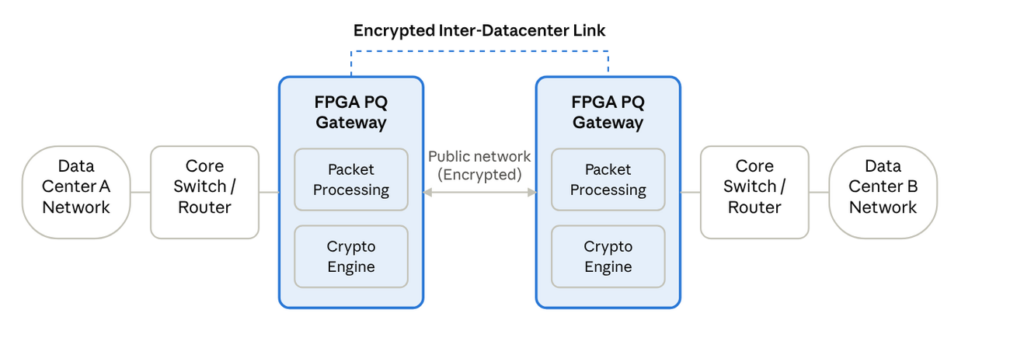
An FPGA gateway at each site protects traffic across the inter-datacenter link, with cryptographic keys established and retained inside the hardware.
Established hardware meets research-backed cryptography
The deployment combines DYNANIC’s packet-processing and integration expertise, FPGA SmartNICs from Silicom, our hardware partner, and cryptographic IP cores supplied by Brno University of Technology (BUT).
Silicom’s established FPGA SmartNIC portfolio provides the hardware foundation. BUT brings cryptographic expertise grounded in scientific research and practical testing: the AES-256-GCM core design is documented in peer-reviewed research published in Springer’s ACNS 2024 Workshops proceedings, including verification against NIST test vectors and measurements on real FPGA hardware. BUT’s encryption technology has also been tested on a high-speed link between VUT and the University of Defence.
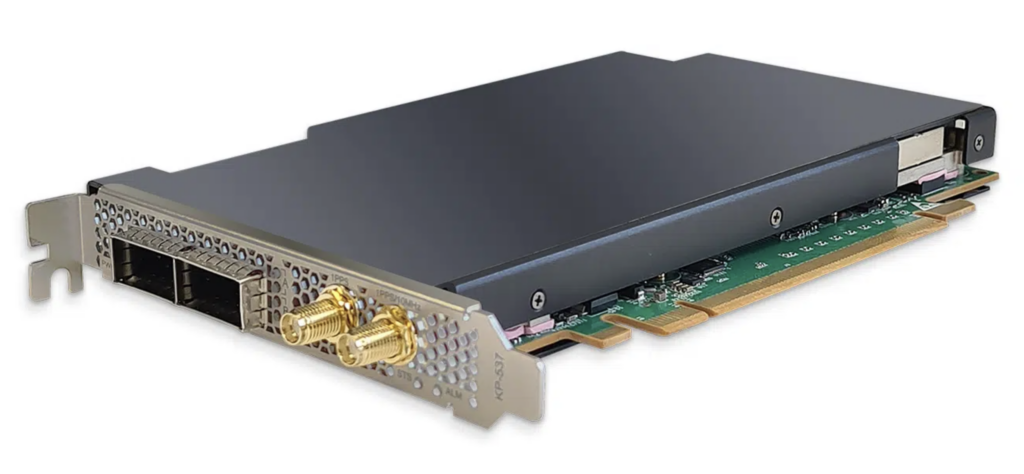
A photograph of the Silicom card model (N6010) used in the Nethost deployment.
Explore the technical details → Download the DYNANIC Post-Quantum Secure Datacenter Interconnect whitepaper.
Another application. The same FPGA flexibility
Nethost’s deployment shows how DYNANIC’s programmable packet-processing foundation can incorporate specialized IP to deliver a new network function. As cryptographic requirements evolve, FPGA firmware can introduce updated algorithms and capabilities on the same hardware platform.
For customers, that means high-speed security today and a platform that can evolve with their requirements.
Read Nethost’s perspective on the deployment on Lupa.cz (in Czech).
Discuss your interconnect security requirements with us: info@dyna-nic.com.